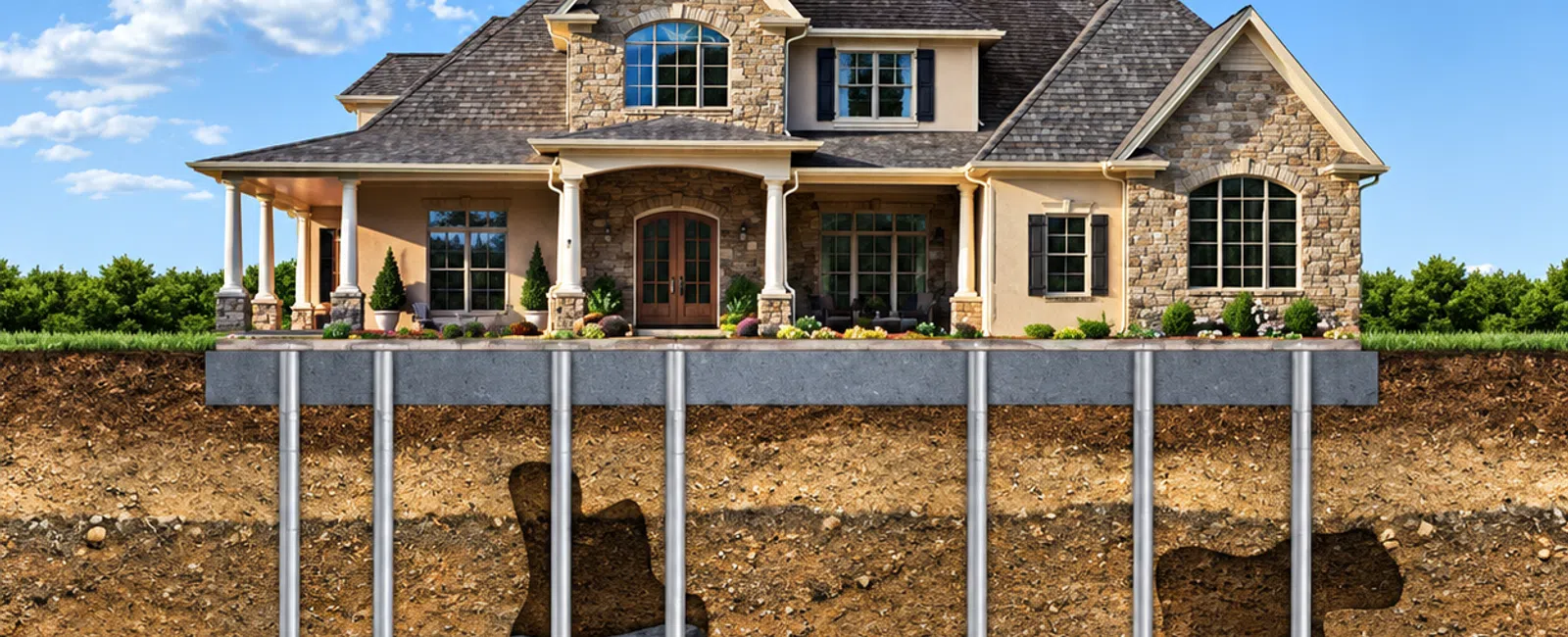
A helical pier is a steel shaft screwed into the ground past the soil that failed, down to a layer that will hold, with a bracket at the top that carries the weight of the house onto it. It is the underpinning method that fits Florida residential foundation repair, because a typical home here is a light single-story slab sitting on loose sand over deep limestone, and a helical pier reaches bearing in that sand without needing a heavy structure or shallow rock to work against.
How Helical Piers Work
A helical pier is a square or round steel shaft with one or more steel helix plates welded near the tip, usually 8 to 14 inches in diameter. A hydraulic drive head on a skid steer or mini excavator rotates the shaft, and the helix plates pull it into the ground the way a wood screw pulls into a board. Extensions bolt on as the lead section goes down, and the pier keeps advancing until it reaches soil dense enough to resist rotation.
The installer reads capacity directly off the machine. The torque required to turn the shaft rises as the helix enters denser soil, and the relationship between installation torque and load capacity is well established for each shaft size. An engineer sets a target torque in the spec, the crew records the torque at every foot of depth, and the pier is accepted when it holds that torque over the last several feet. Load capacity does not depend on the weight of the structure above, which is why helical piers foundation repair works on light buildings, additions, porches, and stem walls that have almost no weight to push against.
Why Helical Piers Fit Florida Sand
The soil profile under most Central Florida homes runs several feet of loose to medium-dense sand, then clayey sand or sandy clay, then limestone that may sit 20 feet down in Marion County or more than 60 feet down near the coast. There is often no shallow bedrock, and the house above is light. Both facts favor the helical pier.
In sand, the helix plates develop capacity by bearing on the plate area rather than by friction on the shaft, so a helical pier reaches working load in dense sand without ever touching limestone. The installer sees it happen as torque climbs through the dense layer. The older alternative, a push pier driven straight down by a hydraulic ram braced against the footing, needs the weight of the house as a counterweight and something hard to refuse against. A single-story block home on a monolithic slab often lifts before a push pier reaches bearing, and the limestone it would need to refuse on is too deep to reach.
The same screw-in action makes helical piles the standard for new foundations on problem soils and for uplift anchors, where the pier resists pull-out rather than settlement. Signs, light poles, docks, and solar arrays on sandy lots use the same hardware for that reason. The question on a settling house is not which pier is strongest but which one can be installed and verified under that house on that soil, and the geotechnical engineering report answers it before anyone chooses.
When Piers Are Not the Answer
Piers fix settlement caused by weak soil near the surface. They do not fix a sinkhole. Where limestone has dissolved and the sand above it is raveling into the void, a pier driven through that sand is standing in material that is still moving, and the void below keeps growing under the slab between the piers. A sinkhole investigation with ground penetrating radar and standard penetration test borings is what separates a raveling zone from ordinary loose fill.
When the borings confirm sinkhole activity, the sequence changes. Compaction grouting comes first: a low-slump cement grout pumped under pressure through a pipe advanced to the limestone, filling the void and densifying the loose sand in a bulb around the pipe as it is withdrawn in stages. Helical piers go in after the ground has been stabilized, or are skipped when grouting alone restores support. A contractor who quotes piers for a sinkhole-pattern crack without borings is selling the wrong repair.
What the Engineer's Spec Covers
A pier installation built from a geotechnical report instead of a sales estimate carries a short set of numbers the crew works to and the inspector checks against. The spec from a foundation repair evaluation typically states:
- Pier locations and spacing along the footing, set from the floor elevation survey showing which sections dropped
- Design load per pier, from the structure weight and the number of piers carrying it
- Minimum installation torque, with a safety factor
- Minimum depth, so a pier cannot be accepted on a thin dense crust above softer soil
- Lift tolerance, how far the slab may be raised and how to stop if the structure resists
The installer's torque log and depth log at each pier go back to the engineer, who confirms the piers met the spec before the brackets are locked off and the excavations closed. That record is what a buyer, lender, or insurer asks for later.
Helical piers fit Florida residential foundation repair because they build capacity in dense sand, prove it by torque, and do not need a heavy house to install. They do not belong under a slab that is settling into a sinkhole until the ground has been stabilized. BTR Foundation Services, the foundation division of Bechtol Engineering, installs helical piles and uplift anchors with crews trained and certified by A.B. Chance, working from Bechtol's own soil borings and elevation surveys across Volusia, Orange, Seminole, Lake, Marion, Brevard, Osceola, St. Johns, and Flagler counties.