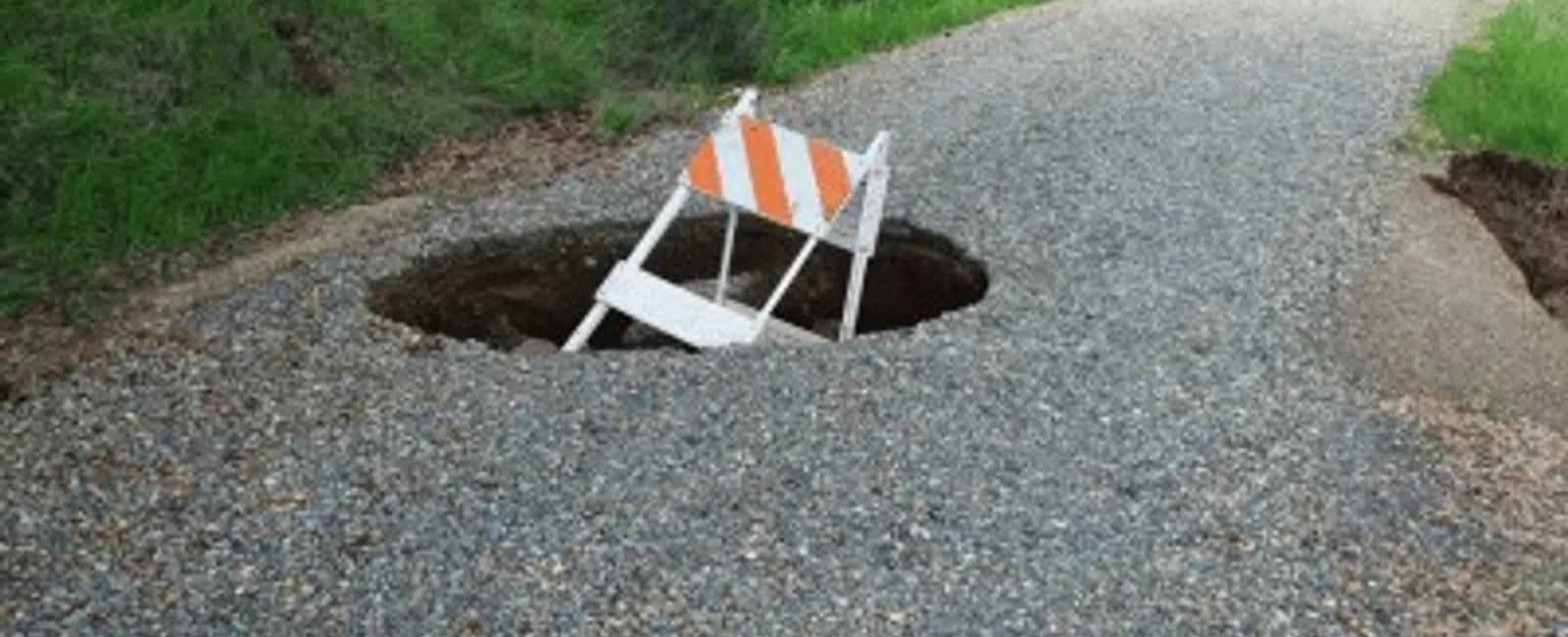
Sinkholes in Florida start with the limestone beneath the state. Rainwater picks up carbon dioxide and turns slightly acidic, and over thousands of years it dissolves that rock and leaves cavities behind. The sand and clay above those cavities wash downward, and the ground at the surface either sags slowly or gives way at once.
What sets off a collapse on a particular day is usually a change in water: a drought that lowers the water table, a storm that soaks the ground in a few hours, heavy pumping nearby, or a broken pipe. For most property owners, though, the first sign isn't a hole. It's a crack in the wall, a door that stops latching, or a low spot in the yard that keeps getting deeper.
Why Florida Has So Many Sinkholes
Florida sits on thick layers of limestone and dolostone, the same carbonate rock that holds the Floridan aquifer. Ground built on rock that dissolves in water is called karst, and the U.S. Geological Survey lists Florida first among the states where sinkholes do the most damage.
The risk isn't spread evenly. Pasco, Hernando, and Hillsborough counties are known as Sinkhole Alley, and the Florida Office of Insurance Regulation reported that two-thirds of the sinkhole damage claimed statewide from 2006 through 2010 came from those three counties. Activity also runs along the I-4 corridor into Central Florida, including Volusia County, where our engineers are based.
The Florida Geological Survey keeps a statewide sinkhole map of reported subsidence incidents, and it's a reasonable place to see what's been reported near a property. Most entries have never been field-checked, so a dot on the map is a report from a witness, not a confirmed sinkhole. Confirming one takes subsurface testing.
What Causes a Sinkhole to Open
Dissolved limestone sets the stage, but a collapse almost always follows a change in how water moves through the ground. These are the triggers we see most often in Florida:
- A falling water table. Groundwater helps hold up the loose soil sitting over a cavity, and when the aquifer level drops, that support goes away.
- Heavy rain after a dry stretch. Drought lowers the water table first, then a tropical storm sends a surge of water down through the soil and washes sand into openings in the rock below.
- Site work and construction. New drainage systems, retention ponds, wells, excavation, and heavy fill loads all change where water goes and how much weight the soil carries.
- Leaking water and sewer lines. A broken pipe can wash out enough soil to open a hole that looks like a sinkhole, even with no karst involved. That's one reason an engineer has to look below the surface before calling it one.
How Does a Sinkhole Form? The Three Types in Florida
The soil on top of the limestone determines how a sinkhole forms and how quickly it shows up at the surface. Geologists group Florida sinkholes into three types.
Type |
Soil Over the Limestone |
How Fast It Develops |
What You See |
|---|---|---|---|
Cover-Collapse |
Clay-rich soil that bridges over a growing cavity |
Abruptly, sometimes over a few hours, once the clay bridge fails |
A steep-sided hole; the type behind most catastrophic damage |
Cover-Subsidence |
Sandy, permeable soil that trickles down into openings in the rock |
Gradually, often unnoticed for years |
Small depressions and slow settling of whatever sits above |
Dissolution |
Little or no soil; limestone at or near the surface |
Slowly, as water dissolves the exposed rock |
A shallow bowl that can fill with water and become a pond |
The slow types matter as much as the sudden ones when a building is involved. Gradual raveling under a foundation shows up as settlement damage long before anything opens up, which is why the warning signs below are worth taking seriously.
Sinkhole Warning Signs Engineers Look For
No single symptom proves a sinkhole. On a site visit, our engineers look for a pattern: several signs at once, damage that keeps getting worse, or problems that cluster around one part of the property.
Outside the building, the early warning signs of a sinkhole in your yard include:
- A circular low spot or depression that deepens over weeks or months
- Fence posts, trees, or utility poles that begin to lean
- New cracks in a driveway, sidewalk, or pool deck, or a pool that keeps losing water
- Foundation edges or tree roots that become exposed as the soil around them drops
- Small, steep-sided holes in the ground, sometimes called chimney holes
- Water ponding where it never collected before, or a pond that suddenly drains
- Cloudy or sandy water coming from a private well
Inside the building, watch for:
- Stair-step cracks in block walls or new cracks running across the slab
- Doors and windows that start sticking or won't latch
- Floors that slope, or tile that cracks along a line
- Gaps opening where walls meet the floor or ceiling
Plenty of these have causes other than karst, and most foundation cracks in Florida homes are cosmetic shrinkage from the concrete curing. The ones worth an engineer's attention keep growing, are wider at one end, or show up alongside the outdoor signs above.
Sinkhole or Settlement: How Engineers Tell the Difference
Settlement and sinkhole activity cause the same kinds of damage, so the cause can only be confirmed below the surface. In Florida, a lot of foundation movement has nothing to do with limestone. Organic soil (muck) left under a slab compresses over time, fill that was never compacted properly keeps settling, and leaking plumbing or poor drainage can wash soil out from under one side of a house.
The difference matters for the repair, and it often matters for an insurance claim. Florida policies treat sinkhole loss differently from other ground movement, and claims tend to turn on what a licensed engineer documents. Our forensic engineering team investigates foundation failures, sinkhole damage, and structural distress, and documents the cause for owners, insurers, and attorneys.
How a Sinkhole Evaluation Works
A sinkhole evaluation answers one question with data from below ground: is there karst activity under this property, and is it causing the damage you see? Our process follows four steps.
- An engineer visits the site, maps cracks and other damage, checks drainage, and reviews nearby reported subsidence incidents.
- Our drill crews advance standard penetration test (SPT) borings around and beneath the affected area. Very low blow counts, the drill rods dropping suddenly, or lost drilling fluid can each point to raveled soil or a void above the limestone.
- Samples from the borings are classified in our laboratory, and organic soil or loose fill is identified if that's what's really behind the movement.
- An engineer analyzes the results and issues a report sealed by a licensed Florida Professional Engineer, with the cause of the damage and a repair recommendation.
We run the borings with our own geotechnical drilling rigs, which keeps scheduling in our hands. Buyers in karst areas often order an evaluation before closing, and developers usually pair one with a geotechnical report before design. For the City of DeLand, we ran a sinkhole evaluation at the Wiley Nash Water Reclamation Facility during its renovation and found that the soils showing past sinkhole activity had been strengthened and stabilized.
What Happens If Sinkhole Activity Is Confirmed
Sinkhole remediation is designed from the boring data, and it usually involves one or both of two methods.
Grouting treats the ground. With compaction grouting, a stiff grout is pumped under pressure into the raveled zone to densify the loose soil and seal the top of the limestone so sand stops moving downward. Chemical grouting is sometimes used closer to the surface to tie loose soil together beneath a slab.
Underpinning supports the structure. Steel piers are installed through the weak soil to a stronger layer below, and the foundation is transferred onto them. Grouting stops the ground from losing support, and underpinning keeps the building level during the process, which is why the two are often specified together.
Repairs are handled by BTR Foundation Services, Bechtol's own division for underpinning, anchoring, and sinkhole remediation. The engineers who found the problem design the repair, and we confirm the grouting worked with follow-up borings instead of assuming it did.
Talk to a Florida Engineer About Your Property
If you're seeing more than one of the warning signs above, or a crack keeps growing, an evaluation will tell you what's happening under the slab before it gets more expensive to fix.
Since 1989, Bechtol Engineering in DeLand has served more than 10,000 clients across Florida. Our team brings 100 years of combined engineering experience, and one of our three licensed Professional Engineers reviews and seals every report. The same firm runs the borings, tests the samples, writes the findings, and designs the repair, so nothing gets lost between contractors.
Tell us about the property and what you've noticed. An engineer reads every request and responds with a scope and schedule. Request a proposal to get started.